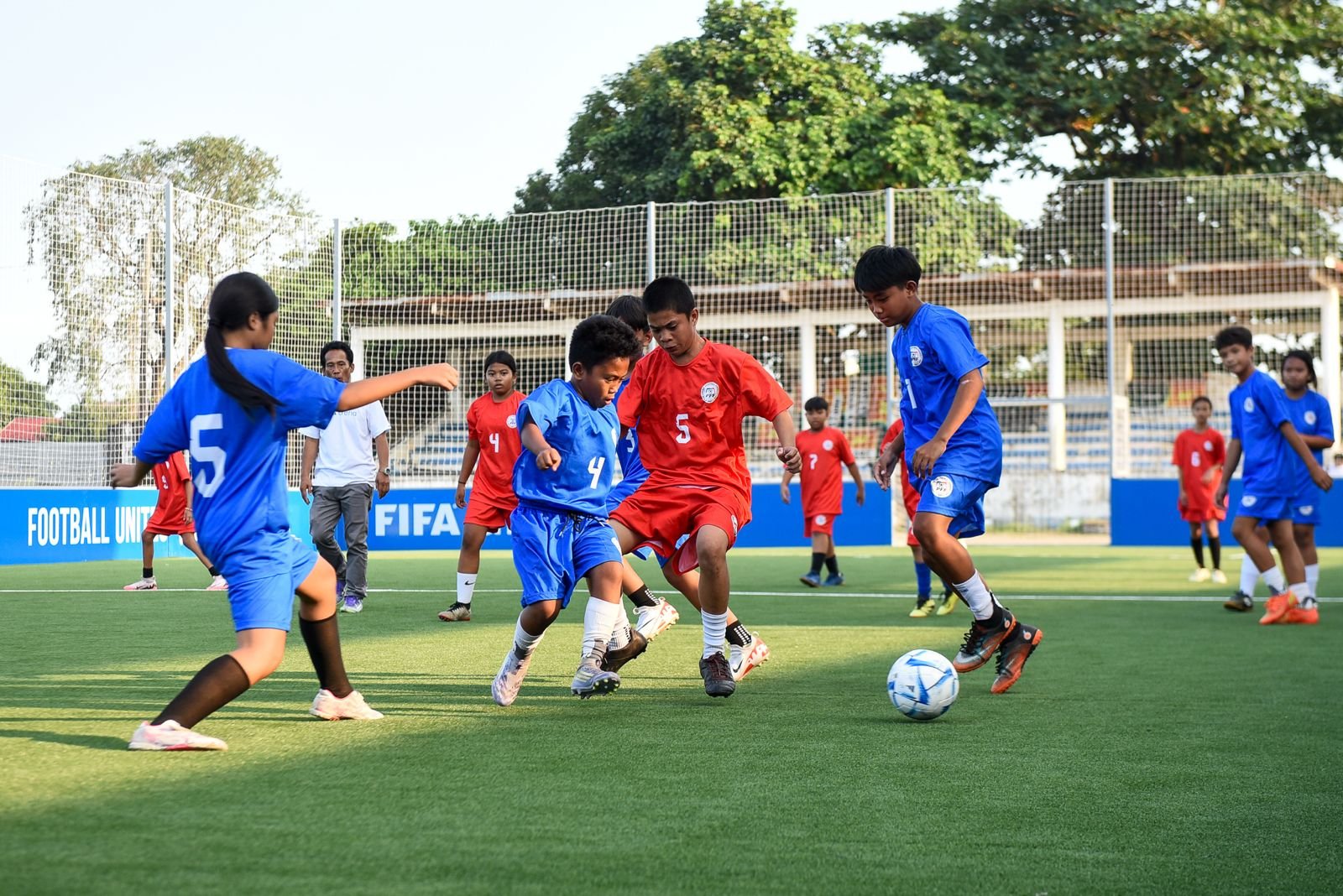
The Department of Education’s (DepEd) decision to implement 8v8 football for the Elementary Boys Division of the 2026 Palarong Pambansa marks one of the most significant structural changes in recent grassroots football history. Understandably, many Filipino parents, coaches, and young athletes—accustomed to seeing football in its full 11-a-side format—are asking why this unfamiliar variant is being introduced in the country’s premier school-based competition.
According to the Philippine Football Federation (PFF), the answer is both simple and profound: 8v8 football is the global standard for children 13 and below, and adopting it is essential if the Philippines is to catch up with modern football-development practices.
Key highlights of how the reform came about
- 2024: PFF Technical Department started discussions with Regional Football Associations (RFAs) on adopting age-appropriate football formats for youth competitions.
- 2024: The proposal of the 8v8 format was presented and adopted by the PFF Executive Committee of which Palarong Pambansa Football Tournament Director Member Rufino “Pines” Arellano is also a member.
- 2024: This was presented to RFAs and adopted during the PFF Extraordinary Congress.
- June 2025: The reform gained further affirmation when PFF President John Anthony Gutierrez attended the FIFA Summit workshop led by FIFA Chief of Global Football Development Arsène Wenger, where 8v8 was highlighted as the optimal format for beginner players aged 13 and below.
- August 4 to 8, 2025: Gutierrez was invited to the Post-2025 Palarong Pambansa Stakeholders Conference in Bayugan City, where he presented the shift to 8v8 format in the elementary boys’ football competition upon the endorsement of PSC Chair Patrick Gregorio.
- February 6, 2026: DepEd, through Memorandum 2026-05-08594 issued by Undersecretary Malcolm Garma, started implementing the shift to 8v8 format. Palarong Pambansa Football Tournament Director and PFF ExCo Member Rufino “Pines” Arellano spearheaded the implementation of 8v8, and also coordination with PFF for guidance.
A carefully studied reform
PFF President John Anthony Gutierrez acknowledged that the change may initially feel unfamiliar to many in the Philippine football community.
We understand why some might question the shift. For decades, Filipinos have only seen the full 11-a-side game. But for young children, 8v8 is the correct, age-appropriate format. This change has been carefully studied by PFF and DepEd, and it is one of the most important reforms we can implement for the future of Philippine football.
Gutierrez emphasized that the decision is not experimental but grounded in years of research, international guidance, and domestic consultations with football stakeholders.
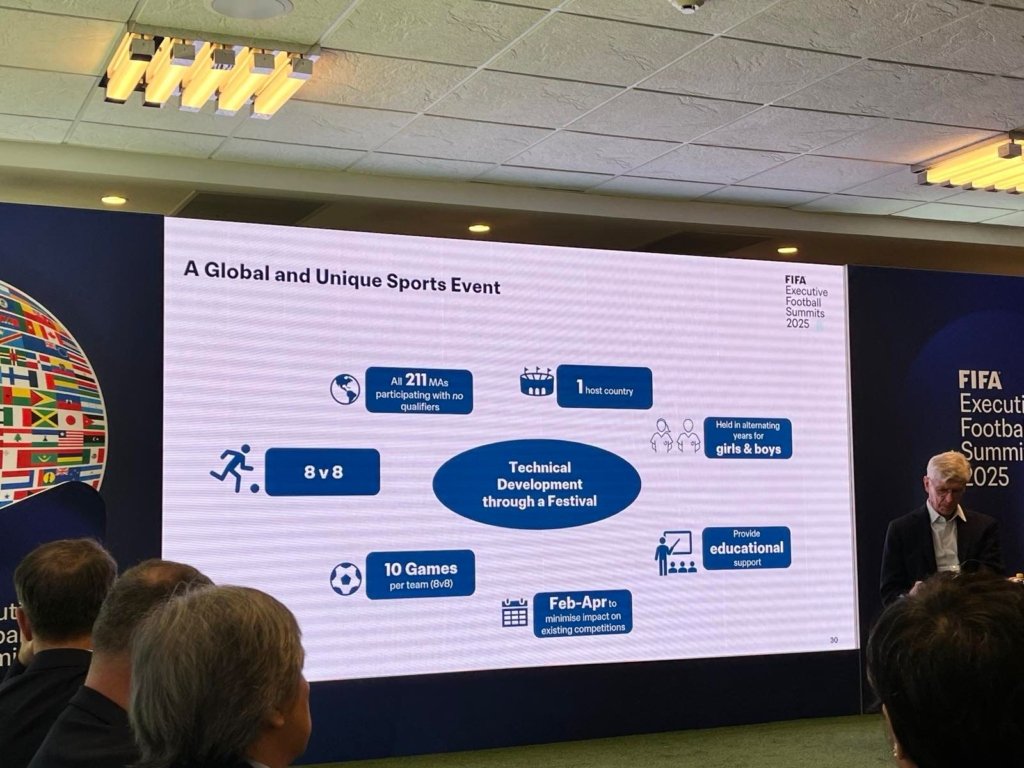
FIFA Chief of Global Football Development and legendary Arsenal coach Arsene Wenger discussed FIFA’s planned international 8v8 tournament during the FIFA Executive Football Summit attended by PFF President John Anthony Gutierrez.
Wenger’s FIFA Workshop: Reinforcing the direction
The push toward 8v8 gained further validation when Gutierrez attended the June 2025 FIFA Summit in Miami. There, he participated in a workshop led by Wenger, whose managerial tenure with Arsenal revolutionized modern coaching and player development.
Wenger presented extensive data explaining why small-sided games such as 8v8 provide the best developmental environment for young players. With fewer players on a smaller pitch, children receive more touches on the ball, make more decisions during play, and develop technical confidence at a faster rate.
“Wenger explained that children need more touches, more decisions, and more involvement,” Gutierrez said. “He showed data proving that small-sided formats create smarter, more technically complete players. Hearing this from someone of his stature reaffirmed that the Philippines must adopt 8v8 now.”
Gutierrez added that FIFA is exploring an international 8v8 youth tournament, signaling the global governing body’s long-term commitment to the format.
Origins of the reform
The push for the 8v8 format began even before the FIFA Summit, in the early days of President Gutierrez’s term. He and PFF Director of Football Vince Santos, a German-licensed coach with a record of 12 UAAP juniors titles in the last 13 seasons and 6 UAAP seniors titles, have been brainstorming about institutionalizing 8v8 as the standard football game for elementary school children. Discussions also included the development of a football philosophy with the 8-player double diamond formation as foundation.
This concept was developed further by former PFF Technical Director Coco Ferré, a Spanish coach from Barcelona with extensive experience in international youth development, strongly recommended adopting progressive small-sided formats—3v3, 4v4, 5v5, and 8v8—as stepping stones toward the full 11-a-side game.
Ferre conducted discussions with Regional Football Associations in 2024, emphasizing that countries with developing football cultures must provide scaled environments that prioritize learning and ball contact. The proposal eventually gained overwhelming support and was formally adopted during the PFF Extraordinary Congress.
The developmental logic
Santos explained that introducing children directly to 11-a-side football often slows down learning rather than accelerating it.
“In 11-a-side, small children spend most of the game chasing the ball in a huge field,” Santos said. “But in 8v8, they get more touches, more decisions, and more meaningful involvement. You cannot develop a player who rarely touches the ball.”
He described 8v8 as the perfect bridge between small-sided games and the full format. The structure allows young players to experience recognizable football roles—defenders, midfielders, wingers, and a striker—while keeping the game manageable for developing minds and bodies.
The 8v8 Shift in the Palarong Pambansa
With the Palarong Pambansa having one of the biggest youth football tournaments in the country where young players develop, it was imperative for PFF to introduce the system to DepEd and PSC.
In August 2025, Gutierrez was invited to the Post-2025 Palarong Pambansa Stakeholders Conference in Bayugan City, where he presented the shift to 8v8 format in the elementary boys’ football competition with the endorsement of PSC Chair Patrick Gregorio.
In 2026, DepEd included the 8v8 format in a Memo on Updates on Palarong Pambansa 2026 dated 6 February. Palarong Pambansa National Football Tournament Director Rufino “Pines” Arellano, who is also a PFF Executive Committee member, coordinated the shift with PFF for guidance, as they prepare to implement it in the upcoming national tournament.
According to Arellano, the adoption of 8v8 will significantly improve how football is played and developed in the country’s largest grassroots sporting event.
“This will have a major impact on how our young athletes experience the game,” he explained. “At the Palarong Pambansa level, we want competitions that encourage learning, skill development, and confidence. The 8v8 format allows more players to participate actively and understand the game better.”
Aligning with global standards
Leading football nations—including Spain, Belgium, Germany, and Japan—rely heavily on small-sided formats for youth development. Elite academies such as those of Barcelona and Bayern Munich structure their training systems around the same principles.
Belgium’s famous “Golden Generation,” for example, emerged after sweeping youth reforms that emphasized small-sided games. Studies conducted by the University of Louvain concluded that formats such as 2v2, 5v5, and 8v8 significantly improved technical development by encouraging dribbling, passing angles, and intelligent movement.
In an article in British newspaper The Guardian, former Belgium technical director Michel Sablon “commissioned the University of Louvain to carry out an extensive study on youth football in Belgium.” The Guardian wrote:
One of the findings in the university research was that there was far too much emphasis on winning and not enough on development. There was also evidence to support the federation’s theory that 2v2, 5v5 and 8v8 were the best small-sided games to encourage children to practice the skills – dribbling and diagonal passing – that were central to their philosophy.
In all, these methods have produced batches of world-class players who mastered technique and game intelligence long before stepping onto a full-sized pitch.
“In leading football nations, no one forces 11-a-side on children,” Gutierrez explained. “If we want to raise the level of Filipino football, we must give our children the same opportunities.”
A reform that will bear fruit
Gutierrez believes the 2026 shift may feel unfamiliar at first, but it represents a game-changing reform that will shape the future of Philippine football.
“This reform is about giving Filipino children a chance to develop properly,” he said. “If we build the right foundation now, it will bear fruit for decades.”
Through the PFF’s Centers of Development and the youth leagues organized by Regional Football Associations, the federation plans to ensure that players gradually progress from small-sided formats toward the full 11-a-side game.
For Gutierrez, the message to the football community is simple.
“If we dream of seeing Filipino players succeed on the world stage, this is where that journey begins.”