The Philippine Football Federation (PFF) is setting a strategic course for 2026, anchored on what President John Anthony Gutierrez described as an “A-plus” performance year for Philippine football in 2025.
In an interview on the sports program Power and Play with former Philippine Sports Commission (PSC) Chair Noli Eala and co-host Jera Sison at One PH on Saturday, President Gutierrez highlighted historic gains across men’s football, women’s football, and futsal, while underscoring that the Federation’s central thrust for 2026 is an aggressive infrastructure rollout nationwide.
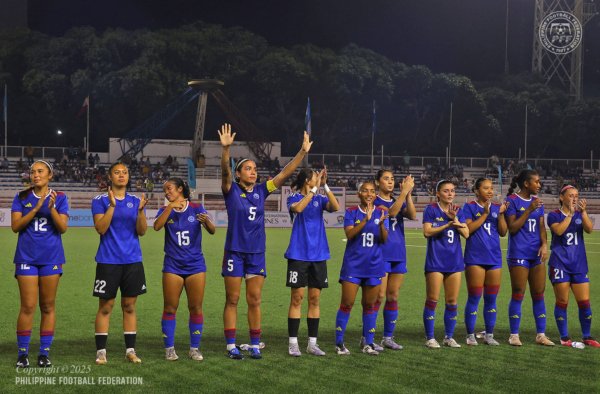
“We’re A-plus for 2025,” Gutierrez said. “The men’s seniors did not lose a single game, the women continued their greatness by qualifying for the Asian Cup, and that long-awaited SEA Games gold was finally delivered by our women’s national team.” He also praised the country’s successful hosting of the inaugural FIFA Women’s Futsal World Cup, noting that FIFA rated the Philippines’ staging of the tournament as “excellent.”
Gutierrez was unequivocal that the PFF’s 2025 success was not an accident.
“The Federation really dug deep. We worked very, very hard,” he said, crediting the Federation’s officials, Executive Committee and staff. But he also emphasized that key institutional partners were instrumental, singling out the Philippine Sports Commission (PSC) under Chairman Richard “Pato” Gregorio.
“If the Philippine Sports Commission is not there, the Futsal World Cup will not continue,” he stressed. This combination of administrative rigor and inter-agency support, Gutierrez explained, set the stage for national teams to flourish at all levels.
When asked whether the Federation could bring back the mainstream popularity enjoyed during the era of Phil and James Younghusband, Gutierrez acknowledged that marketing must be strengthened.
“I tend to focus more on performance on the field,” he admitted. “But marketing is very important. We’re going to start marketing our current players and hopefully reach the status Phil and James achieved.” He added that enhanced visibility, which significantly increased last year through traditional/social media viewership and on-site game attendance, is essential not just for fan engagement but for attracting private-sector support.
Strategic imperative
According to Gutierrez, hosting the World Cup was a strategic imperative for the country.
Gutierrez explained: “We showed the international Federations that we’re not just here to ask for handouts. We’re here to help, promote, provide venues, and do our part.” He emphasized that FIFA, AFC, and AFF now recognize the Philippines as a proactive contributor in the global football community, which directly leads to more more developmental assistance and investment in Philippine football.
This has now yielded the largest infrastructure commitment ever secured by the PFF. For 2026, the Federation will oversee the construction of 21 football pitches across the country, funded collectively by FIFA, the Asian Football Confederation (AFC), and the ASEAN Football Federation (AFF).
Gutierrez confirmed that the 2026 infrastructure portfolio amounts to approximately US$3.6 million. “This year alone, between FIFA, AFC, and AFF, we will be building 21 fields of different sizes around the country,” he said. “The target is by July, but at the latest, all will be completed by December.”
Among the confirmed sites are Tagum, Dumaguete, Sultan Kudarat, Maguindanao, Dipolog, Baguio, Balanga in Bataan, and Palawan. More sites will be announced in coordination with PFF’s 38 Regional Football Associations (RFAs).
Gutierrez clarified that these are world-standard artificial pitches, not soil-based fields. “Here in our country, it rains 60 to 70 percent of the year. When the soil gets wet, it turns to mud. That doesn’t do much for football development,” he said. “When I say building pitches, I’m talking about artificial pitches that you can use 99 percent of the time. Low maintenance, no mud, and high usability for training.”
Both full-size and small-sided pitches will be constructed. Full pitches will be placed in major hubs, while half- and reduced-size pitches will be deployed in every corner of the country. “[This] is the world standard now. Kids shouldn’t start with 11-a-side,” Gutierrez explained. “Up to age 10, kids should be in 5-a-side. Up to age 13, 8-a-side. Then they graduate to 11-a-side. Our plan is very strategic.”
Gutierrez emphasized that the Philippines possesses football “natural resources” that even traditional football powers cannot match.
“We have 16 million kids under the age of six,” he said. “Croatia has only 5 million people. Portugal has only around 14 million. We have what they don’t have—so many children. If we implement the same training methods and provide exposure, we can be the same.”
With infrastructure as the backbone to sustained success and in building Philippine football’s bright future, PFF’s ultimate goal is clear: elevate the Philippines to a football power in Southeast Asia. This is PFF’s mindset as the country’s national football teams are preparing intensively for major campaigns, including the ASEAN Women’s Futsal Championship in February, the AFC Women’s Asian Cup and FIFA Women’s World Cup qualifiers in Brazil in March, the 2027 Asian Cup qualifiers final match between the Philippine men’s national football team, and both men’s and women’s football competitions in the Asian Games in September.
“My target is to be [a] powerhouse in Southeast Asia,” Gutierrez declared. “The only challenge is infrastructure. Once we’ve addressed that, sky’s the limit.”