
The Philippine Football Federation (PFF) was named National Sports Association of the Year, while the FIFA Futsal Women’s World Cup Philippines 2025 received the International Event of the Year award at the 7th Philippine Sports Tourism Awards (PSTA) on Monday, August 24, 2026, at Marriott Manila in Pasay City.
The twin honors recognize PFF’s progress in developing football at every level and its growing contribution to Philippine sports tourism, community engagement and international visibility.
The PSTA is presented by the Sports Turismo Alliance and co-presented by the Philippine Sports Commission (PSC), Philippine Amusement and Gaming Corporation (PAGCOR), Selrahco and Marriott Manila, with the support of the Department of Tourism.
PFF President John Anthony Gutierrez shared the awards belong to the entire Philippine football community.
“To be recognized as National Sports Association of the Year, alongside the FIFA Futsal Women’s World Cup Philippines 2025 being named International Event of the Year, is a tremendous honor for the entire PFF family,” Gutierrez said.
“These awards belong to our players, coaches, referees, officials, volunteers, Regional Football Associations, clubs, schools, partners, sponsors, communities and supporters who continue to believe in Philippine football.”
He added that the recognition reflects the broad progress taking place across the sport.
“As we build on previous achievements of PFF, we are seeing progress at many levels of the game at the same time—from our national teams and grassroots programs to coaching, refereeing, competitions, infrastructure and the strengthening of our regions,” he said. “There is still much work ahead, but Philippine football is growing wider, stronger and more connected.”
Measurable progress across Philippine football
PFF’s recognition as NSA of the Year builds on past years’ advancement of the sport, and follows two years of sustained progress in grassroots participation, youth development, national-team performance, technical education, competitions, infrastructure and governance.
At the grassroots level, PFF’s Football Starts at Home roadshows reached 2,546 children and parents while bringing 35 Regional Football Associations (RFAs) together under a shared development direction.
Through the FIFA Football for Schools program, more than 70,000 footballs were distributed to 261 public schools nationwide. PFF’s Talent Identification Network also scouted 2,043 players through regional tournaments and school competitions, with 82 local coaches participating in the process.
The National U16 and U19 Championships provided competitive opportunities for 437 players from 19 teams, while the Filipina5 Futsal Fiesta connected community-level futsal to the FIFA Futsal Women’s World Cup by reaching 37 regions and more than 1,300 players.
These foundations were matched by significant national-team achievements.
The Philippine Men’s National Football Team rose from 150th in the FIFA World Ranking in December 2024 to 136th a year later. It also defeated Thailand for the first time in 52 years and advanced to the semifinals of the 2024 ASEAN Championship.
The men’s youth teams captured the country’s first international title at the U16/U17 level at the Lion City Cup and reached the SEA Games semifinals at U22/U23 level for the first time since 1991.
The Philippine Women’s National Football Team completed a perfect campaign in the 2025 AFC Women’s Asian Cup Qualifiers without conceding a goal and won the Philippines’ first SEA Games gold medal in football. In 2026, they qualified again for the FIFA Women’s World Cup 2027 after a hard-fought 2-0 battle against Uzbekistan.
Filipina5, meanwhile, qualified for the AFC Women’s Futsal Asian Cup and represented the country in the inaugural FIFA Futsal Women’s World Cup. For the first time, the Philippines reached the SEA Games semifinals in women’s football, men’s football and women’s futsal in the same edition.
Strengthening the foundations of the game
PFF also expanded the technical and institutional capacity supporting these achievements.
The country had 2,209 licensed coaches as of December 2025. The Philippines’ first AFC Pro Diploma course is expected to increase the number of locally based pro-licensed coaches, holding the continent’s highest coaching qualification to 12 in 2026.
The Federation has also initiated the construction of artificial pitches all over the country. Through the help of international partners FIFA, Asian Football Confederation, ASEAN Football Federation (AFF) alongside PSC, local governments, and the private sector, a FIFA Arena (quarter pitch) was successfully launched in Balanga, Bataan in January 2026 and an AFF half-pitch in Tagum City, Davao del Norte, was unveiled in June 2026. In addition, a half-pitch broke ground in Leganes, Iloilo also last June in partnership with Filinvest Land, Inc. Four more half-pitches are to be constructed this year–in Baguio, Dumaguete, Sultan Kudarat, and Maguindanao del Norte–while six quarter pitches will be constructed in Puerto Princesa, Cavite, Isabela town in Negros Occidental, and in three areas in Quezon City.
The admission of six additional RFAs—Bohol, Pangasinan, Puerto Princesa-Palawan, Olongapo-Zambales, Batangas and Cavite—further expanded PFF’s nationwide network.
Governance reforms have likewise strengthened financial oversight, Executive Committee engagement, internal processes, staff professionalization, performance management and human-resource policies.
Continuing cooperation with FIFA, the Asian Football Confederation and the ASEAN Football Federation, together with FIFA’s technical and development missions to the country, reflects the international football community’s confidence in PFF’s direction and capacity.
“Our goal is not simply to win awards,” Gutierrez said. “It is to build a football system that will continue producing players, coaches, referees, competitions and opportunities for many years.”
“We share this recognition with everyone who has contributed to that work, especially our RFAs. With strong collaboration, unity and cooperation, we can accomplish much more for Philippine football.”
The Philippines’ first FIFA World Cup tournament
The FIFA Futsal Women’s World Cup Philippines 2025 represented a landmark achievement for Philippine sport. Held from November 21 to December 7, 2025, at the Philsports Arena in Pasig City, the tournament marked the first time the Philippines hosted a FIFA World Cup competition.
The inaugural tournament welcomed teams from 16 countries across Asia, North America, Latin America, Africa, Europe and Oceania. It generated a total attendance of 38,471 and brought together hundreds of athletes, coaches, officials, volunteers and event personnel.
Filipino supporters and young futsal players from Luzon, Visayas and Mindanao also traveled to Pasig to watch the world’s leading women’s futsal players compete on Philippine soil.
PFF extended the tournament’s reach through the nationwide Filipina5 Futsal Fiesta. Winners from participating RFAs were flown to Manila and accommodated by the Federation, allowing young players from across the country to experience the historic event firsthand.
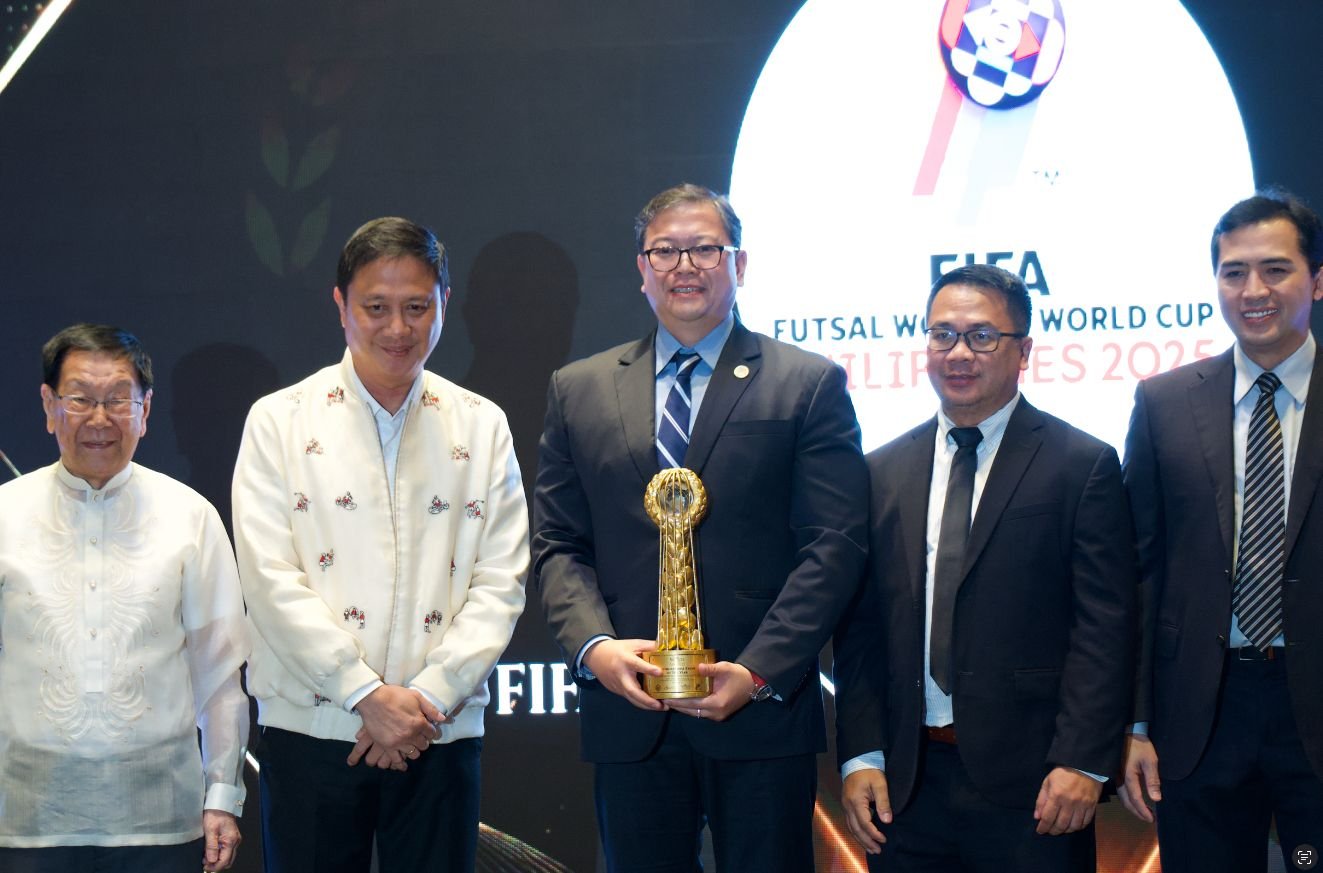
PFF President John Anthony Gutierrez received the Philippine Sports Tourism Awards International Event of the Year for the 2025 FIFA Futsal Women’s World Cup held at the Philsports Arena, Pasig City.
“It was a great honor for FIFA to entrust the Philippines with such a prestigious event, and we are grateful to the Sports Turismo Alliance for this recognition,” Gutierrez said.
He also credited other Philippine NSAs whose successful hosting of major international competitions helped strengthen the country’s reputation as a reliable sporting destination.
“We also thank our fellow NSAs. Their successful hosting of major events in basketball, volleyball, gymnastics and other sports helped build international confidence in the Philippines,” he said. “The FIFA Futsal Women’s World Cup was a success because of the collective efforts of everyone involved.”
Football bringing people to Philippine destinations
Football’s contribution to sports tourism extended beyond the World Cup.
In 2025, the Philippines hosted three matches in the 2027 AFC Asian Cup Qualifiers, with the national men’s team facing Maldives, Tajikistan and Timor-Leste. The matches attracted a combined attendance of 15,544.
The qualifiers included the first international football match hosted at New Clark City Stadium in Capas, Tarlac, bringing supporters to Central Luzon and demonstrating the potential of football to activate venues and destinations outside Metro Manila.
PFF and GoTyme Bank also staged the GoTyme Match Day featuring the Filipinas and Uzbekistan at Rizal Memorial Stadium on October 29, 2025, drawing 3,106 spectators.
Fan zones at these matches gave micro, small and medium enterprises opportunities to sell food, beverages and merchandise. Performances by Filipino artists G22 and Mayonnaise further enhanced the match-day experience while promoting Original Pilipino Music.
Youth competitions strengthening domestic tourism
PFF also launched its inaugural National U16 Boys’ Championship, with regional qualifiers beginning in August 2025 and the national finals held in May 2026. The competition ran alongside the National U19 Championship, with the two national finals staged in Bago City and Victorias City, Negros Occidental.
Players, coaches, families and supporters traveled from different parts of the country to participate in and watch the competitions. Regional qualifiers also generated activity in host communities throughout the tournament period.
In 2026, PFF launched the RFA youth leagues to provide more competitions and talent identification opportunities for younger players.
By taking national youth competitions beyond traditional football centers, PFF strengthened the connection between player development, regional participation and domestic tourism.
The awards recognize not only individual tournaments, but a broader effort to use football to create opportunities for athletes and communities while showcasing Philippine destinations to domestic and international audiences.
For PFF, the twin honors provide further impetus to build on the gains of the past two years and continue using football as a vehicle for development, unity, national pride and tourism.