The Philippine Football Federation (PFF) proudly celebrates 2025 as a transformative year of progress in Philippine women’s football development. Building on the historic momentum of the Filipinas’ 2023 FIFA Women’s World Cup appearance and Asian Games debut PFF has prioritized a robust talent pipeline—from grassroots identification through youth national teams to the senior squad—ensuring sustained success and long-term competitiveness. This structured approach, emphasizing youth integration and homegrown talent, has yielded groundbreaking achievements.
In 2024, the senior Filipinas navigated a challenging yet foundational period with elite friendlies and invitational tournaments, including the Pinatar Cup and matches against South Korea, Finland, Scotland, Slovenia, Kenya, and Jordan. Despite mixed results, the team established resilience during a management transition. A highlight came on October 26 with a commanding 3-0 victory over Jordan at the Pink Ladies Cup—the first win of the year, a clean sheet, and the largest margin against a strong West Asian side.
The breakthrough arrived in 2025. The Filipinas swept the 2026 AFC Women’s Asian Cup Qualifiers in Group G without conceding a goal: 3-0 over Saudi Arabia, 6-0 over Cambodia, and 1-0 over Hong Kong. This flawless campaign earned national acclaim, including House Resolution No. 580 from the Philippine House of Representatives, which commended the team as a “formidable contender” on the global stage. PFF President John Anthony Gutierrez expressed pride: “This is a strong testament to the dedication and determination of our players, coaches and staff. This achievement is fueled by the unity and pride in the hearts of Filipinos everywhere.”

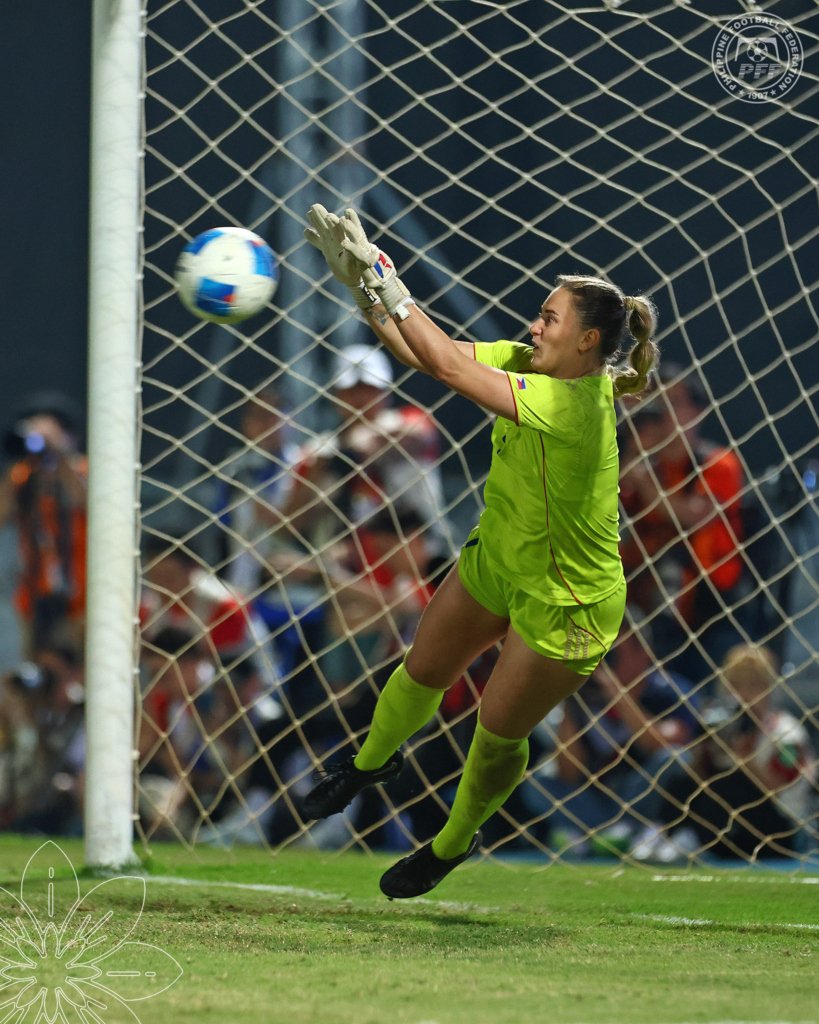
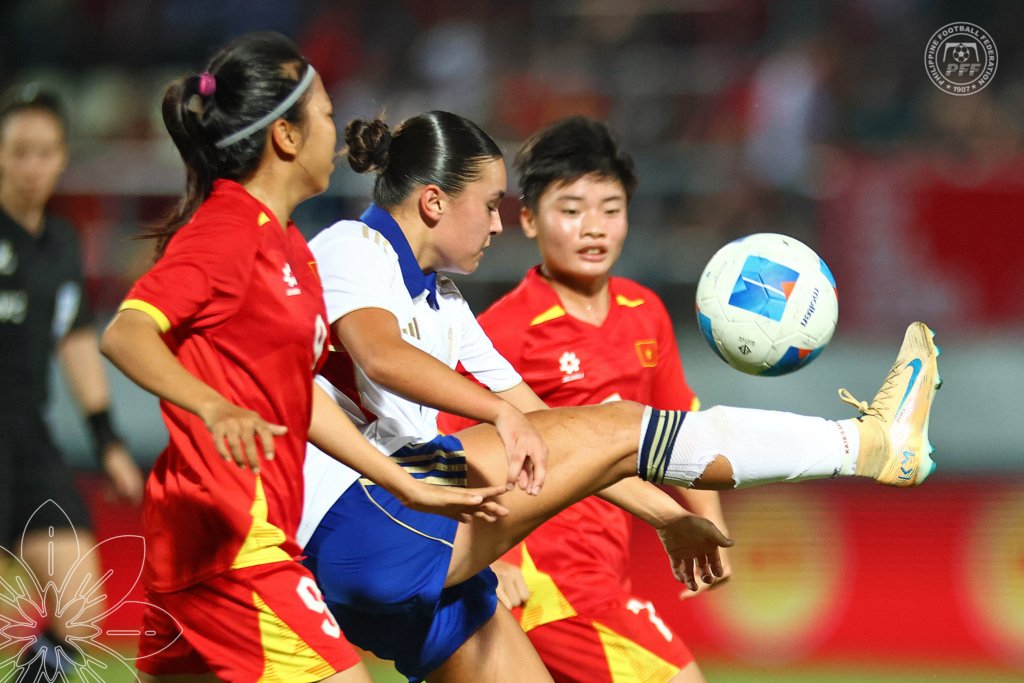
Momentum continued at the ASEAN Women’s Championship–Serenity Cup, where a youthful squad (average age 21) secured a 7-0 win over Timor-Leste, a 1-1 draw with Myanmar, and a narrow 0-1 loss to Australia U23. The pinnacle was the 33rd Southeast Asian Games in Thailand, where the Filipinas claimed the nation’s first-ever football gold medal. Victories included 6-0 over Malaysia, 1-0 over Vietnam in the group, 1-1 (4-2 penalties) over Thailand in the semis, and a dramatic 0-0 (6-5 penalties) final win over Vietnam. Goalkeeper Olivia McDaniel’s decisive save sealed the triumph. Head coach Mark Torcaso praised the squad: “The girls have been absolutely outstanding… I’m so happy for them, for our fans here, and for everyone back home in the Philippines.”
This gold was powered by seamless youth integration. Teenagers from the 2024 U17 program—Alexa Pino (hat-trick vs. Malaysia), Nina Mathelus, Ariana Markey, and Jael Guy—transitioned fluidly into senior roles. Team captain Hali Long reflected: “We dug deep. We showed a lot of heart. And we did this for the Philippines. And we did this for every little girl who wants to dream big.”
At the youth level, the Filipinas U17 exemplified the pipeline’s effectiveness. In 2024, they debuted at the AFC U17 Women’s Asian Cup with a 6-1 win over Indonesia and a 1-1 draw against South Korea. In 2025, under Head Coach Pradhyum Reddy and Team Manager Selu Lozano, they swept qualifiers (5-0 vs. Syria, 2-0 vs. Tajikistan, 4-0 vs. Malaysia) for a second consecutive finals berth—largely with homegrown players. Lozano noted: “This qualification shows that shift taking shape: the majority of our 23-player squad were homegrown, trained on local soil, and several of them played decisive roles. That’s real progress.”
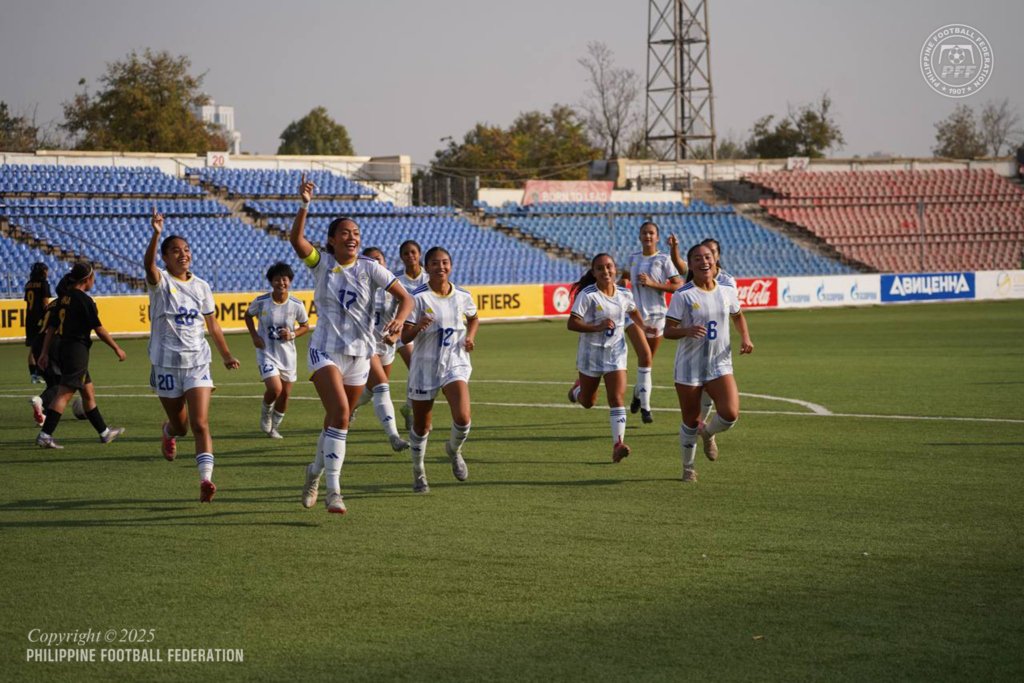
Gutierrez highlighted the broader impact: “PFF stands with them and will continue to support the team throughout the campaign. It is imperative for PFF to strengthen the youth programs of the women’s side as a lot of the previous U17 players have progressed to being leading players of the women’s national team.”
These successes stem from PFF’s strategic initiatives, highlighted by the PFF Women’s Football Strategy Workshop co-facilitated by FIFA experts Arijana Demirović (Head of Development in Women’s Football Division), Simon Toselli (FIFA Technical Expert), and PFF Head of Women’s Development Camille Rodriguez. Held over four sessions culminating in November 2025, the seminar brought together Regional Football Associations (RFAs), clubs, coaches, national team players, administrators, academy directors, and community leaders to align on a unified national strategy.
Aligned with FIFA’s Women’s Football Strategy – Football Unites the World, the workshop focused on expanding girls’ grassroots access, increasing opportunities for women coaches and referees, strengthening competition structures, improving facilities, accelerating digital visibility, and ensuring clear pathways from grassroots to elite levels. Rodriguez, a former Filipinas skipper, emphasized: “With the sport evolving so quickly and with everything we’ve achieved, there was a need to revisit our game plan and elevate it. We engaged as many stakeholders as possible to hear their challenges, their opportunities, and their vision.”
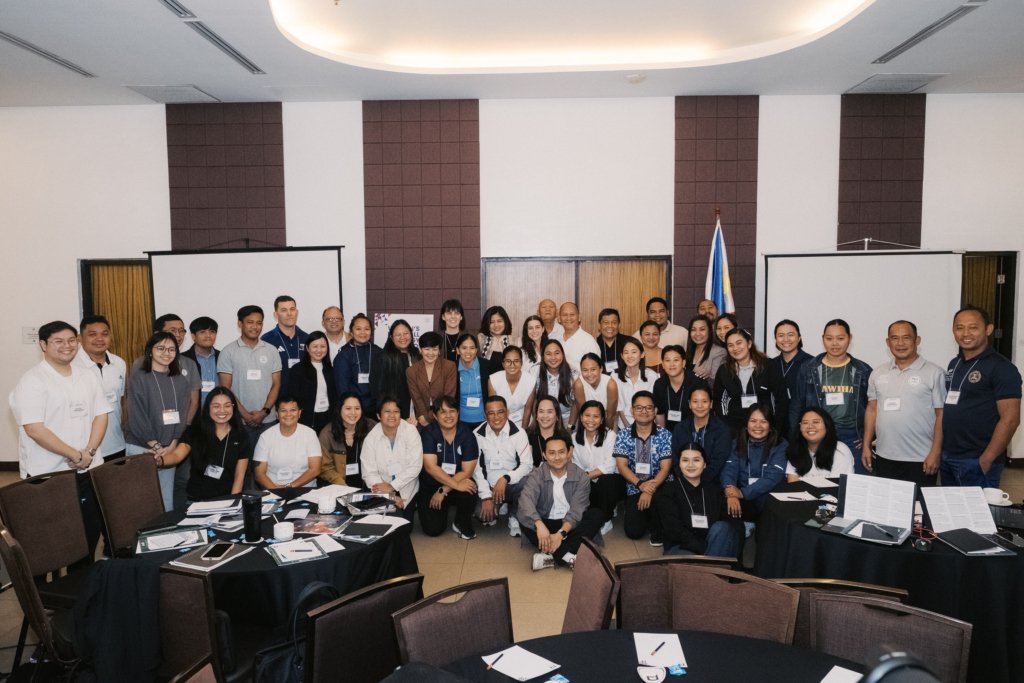
This hands-on governance approach exemplifies PFF’s commitment to collaborative, inclusive decision-making. By directly involving regional leaders and grassroots practitioners in strategy formulation, the Federation ensures that national plans reflect local realities, foster ownership across the country, and build sustainable capacity. Demirović praised the process: “What is really empowering and positive is that there is a lot of work already going on in all parts of the Philippines. There’s a lot of passionate people in the regional associations, in the clubs, a lot of female coaches, [and] former players that are willing to give more to the game.”
Toselli added: “It was a very positive and dynamic process… We got plenty of new ideas from this process.” The resulting Women’s Football Strategy, set for launch in 2026, will guide long-term growth and position the PFF as a model of proactive, transparent leadership in Asian women’s football.
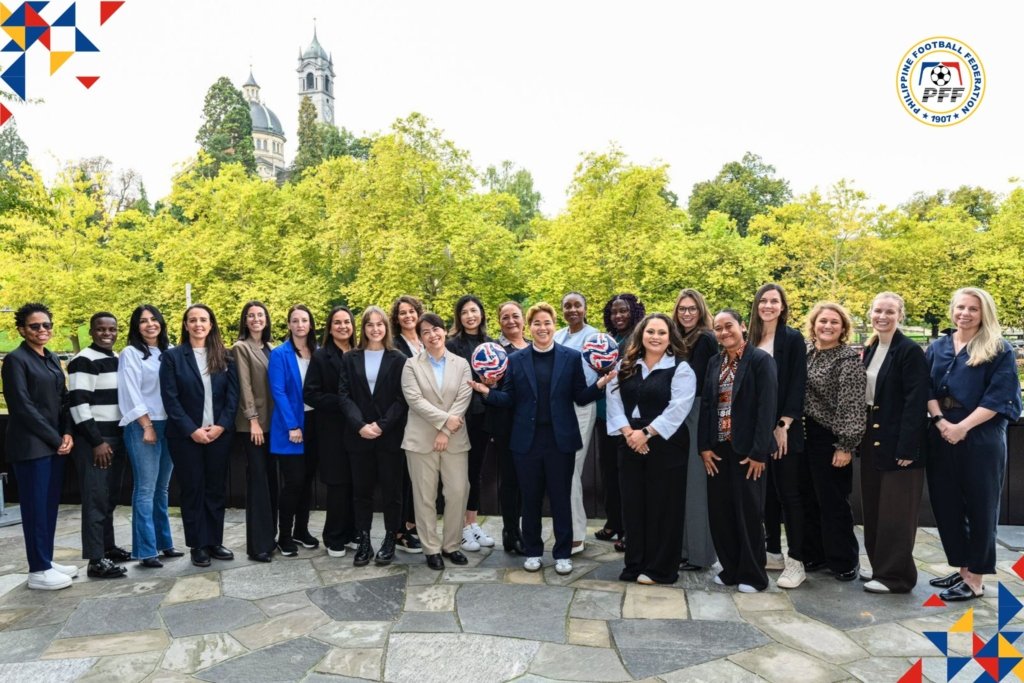
Furthermore, the space for Filipino women leaders in football widened in 2025. Isabella Fernando, PFF Executive Committee (ExCo) member, represented the Philippines at the FIFA Women in Football Leadership Programme (WFLP) held in Zurich, Switzerland in October while fellow PFF ExCo member Atty. Renee Songalia was appointed as member of the FIFA Beach Soccer Committee. In November, the PFF Congress elected Filipinas team captain Hali Long to the PFF ExCo, further cementing not only representation, but women’s empowerment in leadership positions in the Federation.
Looking ahead, the Filipinas eye the 2026 AFC Women’s Asian Cup in Australia—Group A against hosts Australia, Korea Republic, and IR Iran—as a pathway to World Cup qualification for Brazil 2027. The U17 squad targets strong showings at the 2026 AFC U17 Women’s Asian Cup in China, with semifinalists advancing to the FIFA U17 Women’s World Cup.
Gutierrez concluded: “The SEA Games gold medal gold medal is a defining moment for Philippine football and a testament to generations of Filipinas who dreamed of standing on top of the SEA Games podium. To our regional associations and partners, these achievements demonstrate our commitment to excellence and sustainability. We invite continued collaboration and investment as we build toward greater heights, including World Cup qualification in the upcoming 2026 AFC Women’s Asian Cup and the 2026 AFC U17 Women’s Asian Cup.”