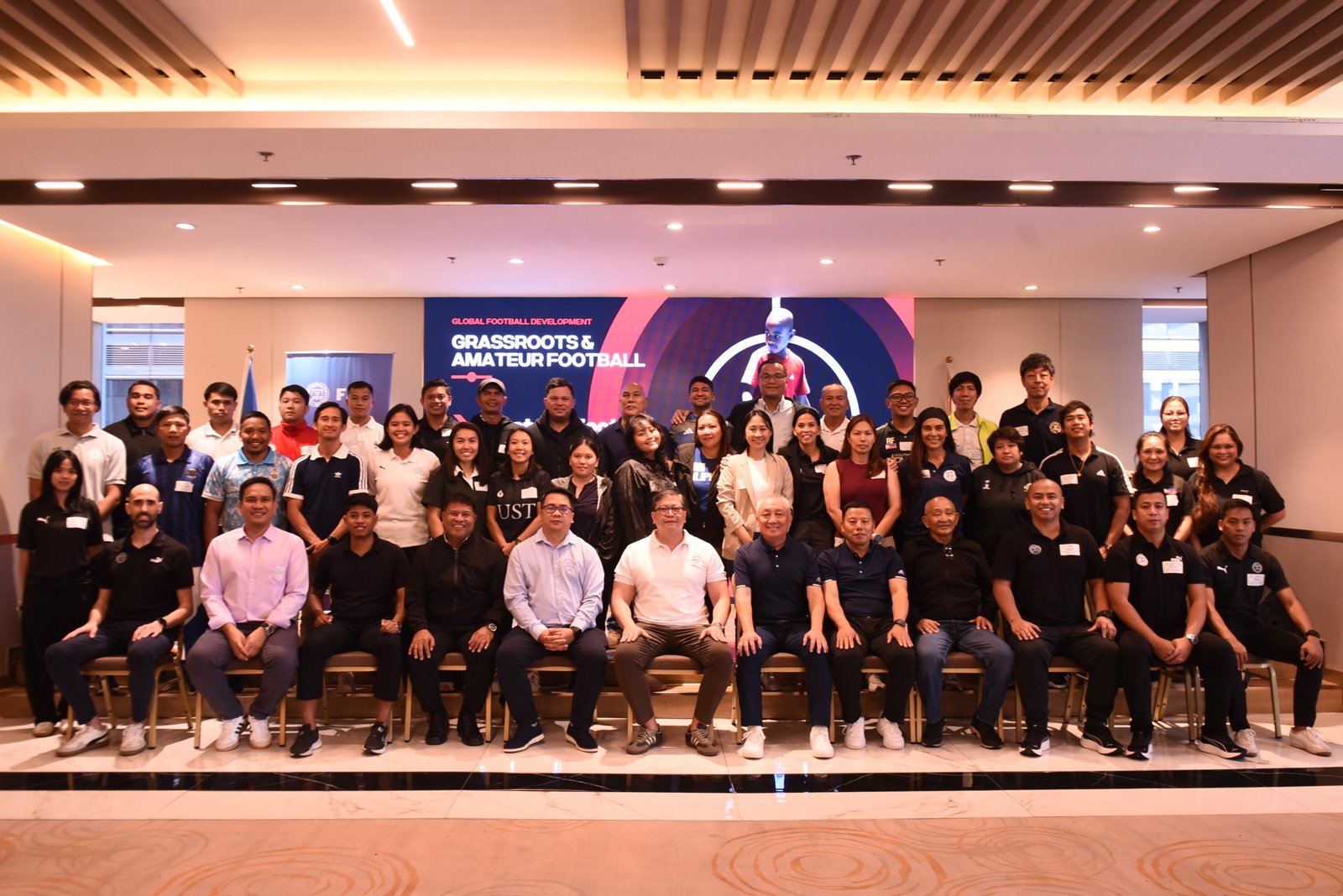
In a landmark gathering aimed at reshaping the landscape of local football, the Philippine Football Federation (PFF) hosted the FIFA Amateur Football Environment Analysis Presentation on March 16 in Pasig City. The seminar brought together Philippine football coaches, managers, regional stakeholders, and PFF staff to align the country’s grassroots initiatives with FIFA’s global vision.
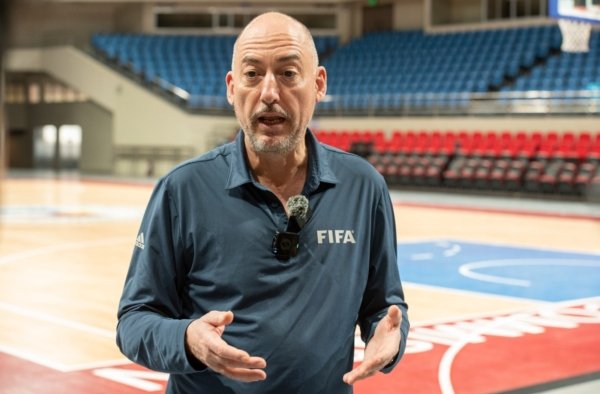
The sessions were led by FIFA Regional Technical Consultants Mike Wong (Singapore) and Chokey Nima (Bhutan), who detailed FIFA’s strategic pivot toward amateur football for the upcoming 2027–2030 cycle.
Setting the tone for the seminar, Wong emphasized that while previous ecosystem analyses focused heavily on elite football and the Talent Development Scheme (TDS), the future relies on the foundation of the sport.
“We have to change our mindset,” Wong explained to the attendees.
In the next cycle, from 2027 to 2030, we are looking at amateur football because this is the biggest part of football in the world. 99% play amateur football.
Nima expanded on this by presenting the findings of FIFA’s extensive Amateur Football Environment Analysis. Conducted between 2023 and 2025, the research is the largest of its kind, capturing half a million data points across 125 participating member associations (MAs). Nima provided critical statistics to highlight the stark developmental gaps and massive potential for growth within the Asian Football Confederation (AFC):
- Population vs. participation: While the AFC accounts for roughly 4.7 billion people (nearly 50% of the world’s population), it registers only 1.7 million players, representing just 6% of registered players worldwide.
- The UEFA contrast: In contrast, UEFA member nations account for 876 million people (11% of the global population) but boast 16.2 million registered players, making up 57% of the global share.
- Coaching infrastructure: Globally, there are over 1 million licensed coaches, averaging roughly 289 registered coaches per 1 million people.
- Gender disparities: The global data revealed a drop-off in female participation as players age. While overall female participation sits around 21%, it drops to just 12% at the senior level, underscoring the need for sustained retention programs.
“For high performance [football], the objective is global competitiveness. But for amateur football, the objective is to increase global participation and grow the game,” Nima stated, challenging the PFF and local stakeholders to bridge the statistical gap and leverage the Philippines’ large population.
Following the presentation of FIFA’s data, PFF President John Anthony Gutierrez addressed the federation’s aggressive steps to modernize local football. He stressed that adapting to FIFA-mandated youth formats and overhauling grassroots infrastructure are non-negotiable steps for the country’s long-term success.
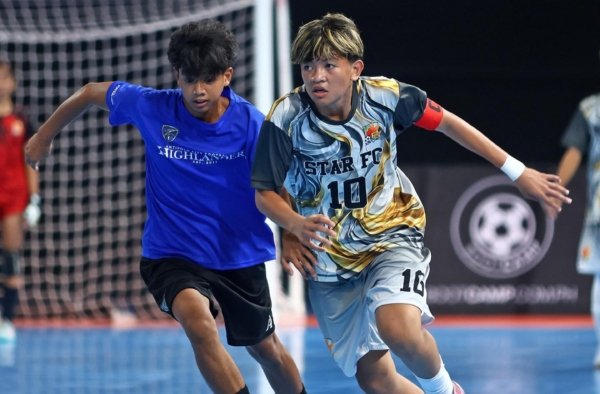
“If you insist on doing the same thing over and over again, and expecting different results, that is insanity,” Gutierrez remarked. He addressed recent criticisms regarding the implementation of the 8-a-side (8v8) format for under-13 competitions, explaining that the smaller format—and its associated “double diamond” tactical formation—is essential for the physical and technical development of young Filipino athletes.
Gutierrez also highlighted a strengthened alliance with the Department of Education (DepEd), facilitated by PFF Executive Committee member Rufino Arellano, ensuring that PFF-backed formats are regularized in national youth platforms like the Palarong Pambansa.
To support the shift to small-sided games, PFF announced a massive infrastructure push. Over the next 16 to 18 months, the federation will petition FIFA, the AFC, and the ASEAN Football Federation (AFF) for funding to construct “quarter pitches” measuring 40 by 20 meters across the Philippines.
Gutierrez called upon the Regional Football Associations (RFAs) to secure five-year usufruct agreements for land to host these facilities. “We’re going to put this around the country, accessible to all the kids,” Gutierrez said. “The kids will have to learn close-quarter play. We want everybody in the Philippines to learn the small-sided game.”
To spearhead this tactical evolution, PFF formally announced the appointment of Coach Rafa Merino as the new Technical Director during the seminar. Leveraging his extensive background in futsal, Merino is tasked with instilling a culture of high-IQ, small-sided play—emulating the quick, precise passing structures utilized by top Asian nations like Japan.
Furthermore, PFF is set to revolutionize local coaching education. Gutierrez announced that the Philippines will host its first-ever Pro-License coaching course this year. The initiative aims to produce more Pro-License coaches within the next year, exponentially increasing the highest tier of football education available in the country.
“It is not pretty, but it will be effective,” Gutierrez added. He concluded:
When will it be effective? Not tomorrow. In 4 to 8, maybe 12 years. But we have to plant the seeds to do so. We are still in the infancy stage of football, and we must admit that to move forward.